
 Dispute Resolution


How to recover a debt under a receipt in Uzbekistan — and what to do without one
You can recover a debt through the courts even if the borrower has stopped answering your calls. A written receipt makes it easiest, but you still have a case without one if bank transfers, messages or other traces of the loan survive. Below, step by step: how to demand the money, how much time you have, where to file a claim, what it costs and how to stop the debtor from hiding assets.
When is a written receipt required and what should it say
Under the Civil Code, a loan agreement is concluded at the moment the money is handed over (Article 732). If the loan exceeds 10 times the base calculation amount (BCA), an agreement between individuals must be in writing (Article 733). From 1 September 2026 the BCA is 440,000 soums, so the threshold is 4.4 million soums. The borrower's receipt counts as the written form of the loan. You do not need a notary.
A good receipt is handwritten and signed by the borrower and includes:
- full names and passport details of the borrower and the lender;
- the amount in figures and words, and the currency;
- the words "received as a loan" — specifically a loan, not "for safekeeping" or "as a gift";
- the repayment date or the condition "on demand";
- interest, if you agreed on it;
- date, place and signature.
If you already have a receipt, keep the original. You file a copy with the court and show the original at the hearing.
Where to start: a demand for repayment
If the receipt states a date, the debt must be repaid by then. If there is no date, the borrower has 30 days from the day you demand the money (Article 735 of the Civil Code). So the first step is a written demand.
- Write the demand: who borrowed how much and when, on what basis (receipt, transfer), and the date by which the money must be returned.
- Send it in a way that leaves proof: by registered mail with acknowledgment of receipt, or hand it over in person and ask the borrower to sign your copy.
- Send the same text by messenger as well. A reply such as "I remember, I'll pay later" is valuable evidence.
- Wait until the date in the receipt, or 30 days if there was no date.
The law does not require a pre-trial demand for a loan between individuals, but it starts the 30-day period and often gets the money back on its own.
How much time do you have
The general limitation period is three years (Article 150 of the Civil Code). It runs from the day the repayment date passed. If the loan was "on demand", the clock starts once the 30 days after your demand have expired (Article 154).
The period is interrupted and starts again if the debtor acknowledges the debt: repays part of it, asks for more time or promises in writing to pay (Article 157). A court applies the limitation period only if the debtor asks for it (Article 153). Still, do not count on the debtor forgetting to raise it.
Where to file a claim and how much it costs
The claim goes to the inter-district, district (city) civil court at the debtor's permanent place of residence (Article 33 of the Civil Procedure Code). If you do not know where the debtor lives, you can file where their property is or at their last known address (Article 34). You can file on paper, by post or electronically (Article 188), including through the my.sud.uz portal.
Attach to the claim:
- a copy of the receipt or other evidence of the loan;
- a calculation: principal, interest, penalty;
- a copy of your demand and proof that it was sent;
- the receipt for the state fee;
- copies of the claim and attachments for the defendant.
The state fee for a monetary claim in a civil court is 4% of the amount claimed, but not less than 1 BCA (annex to the Law "On State Duty"). If you win, the court will order the defendant to reimburse it.
Example. Suppose you lent an acquaintance 20 million soums, the deadline has passed and she does not respond. The fee will be 800,000 soums (4% of 20 million). If you add late-payment interest to the claim, the fee is calculated on the total.
The court must decide the case within one month after preparation is complete, or up to two months in complex cases (Article 207 of the Civil Procedure Code).
Is there a faster route — a court order
If the debt is based on a notarised agreement, or on a written transaction that the debtor does not dispute, you can apply for a court order (Article 171 of the Civil Procedure Code). A judge issues it within three days without a hearing. But if the debtor sends objections within 10 days, the order is cancelled (Article 181) and you will have to file an ordinary claim. So a court order only makes sense when the debtor has nothing to dispute.
What you can recover on top of the debt
- Contractual interest, if it was stated in the receipt (Article 734 of the Civil Code).
- Late-payment interest — from the day the money was due until the day it is repaid (Articles 736 and 327 of the Civil Code). It is calculated at the bank discount rate. Attach a precise calculation to the claim; the court will check it.
- A contractual penalty — only if the receipt or agreement expressly provides for one (Article 260 of the Civil Code).
- Legal costs — the state fee, postage and reasonable costs of a representative.
How to stop the debtor from hiding assets
If there is a risk that the debtor will sell a car or move money away, ask the court for interim measures together with the claim or later (Articles 105–106 of the Civil Procedure Code). The court can freeze the defendant's property and money, including bank balances, or prohibit certain actions. In your application, explain why the judgment would be hard to enforce without these measures — for example, attach an advertisement offering the car for sale.
There are limits: the freeze must be proportionate to the claim, and in cases like this salary, pension and student grants cannot be frozen. If the claim succeeds, the freeze stays in place until the judgment is actually enforced (Article 112 of the Civil Procedure Code).
What if there is no receipt
A missing receipt does not make the loan invalid. But if the amount exceeds 10 BCA, you cannot prove the loan with witness testimony (Articles 109 and 733 of the Civil Code). You can, however, use written and other evidence. If the amount is 10 BCA or less, the agreement can be made orally, and witnesses are admissible.
What can replace a receipt:
- A bank transfer card-to-card or to an account — especially if the payment reference says "loan".
- Messages on Telegram, WhatsApp or SMS in which the person discusses the debt, asks for more time or promises to repay.
- Audio and video recordings of conversations about the debt.
- Partial repayments — transfers from the debtor back to you.
One important detail: under the Civil Procedure Code, a printout or screenshot of messages is not written evidence in itself unless a notary has certified it (Article 89² of the Civil Procedure Code). So keep the phone with the conversation and have the messages certified by a notary in advance — especially if the debtor might delete them.
Example. An acquaintance borrowed 15 million soums in cash and wrote no receipt. A month later she replied on Telegram: "I remember the 15 million, I'll pay you back after New Year." That message confirms both the loan and the acknowledgment of the debt, which also interrupts the limitation period.
If the money was transferred and the debtor claims it was a gift, you can demand its return as unjust enrichment (Article 1023 of the Civil Code). The debtor would then have to prove that you knew there was no debt or that the money was a gift (Article 1030).
Should you go to the police? Failing to repay a debt is, on its own, a civil dispute. A fraud complaint only makes sense if the person never intended to repay and deceived you from the start.
You have a judgment — what next
Once the judgment takes effect, the court issues a writ of execution within five days or, at your request, sends it to the enforcement officer. Individuals receive the writ in their personal account on my.gov.uz (Article 448 of the Civil Procedure Code). The Bureau of Compulsory Enforcement collects the debt: it freezes accounts and property, deducts part of the salary and can restrict travel abroad. The writ can be submitted for enforcement within three years (Article 27 of the Law "On the Execution of Judicial Acts and Acts of Other Bodies").
When to call a lawyer
People often handle simple cases with a receipt on their own. A lawyer's help matters most if:
- there is no receipt and the loan has to be proved through messages, transfers and recordings — it matters which evidence the court will accept and how to prepare it properly;
- the limitation period has almost run out, or when it began is disputed;
- the debtor claims they never received the money or received less;
- you need an urgent freeze on assets before they are sold;
- the debtor lives abroad or the debt is in foreign currency.
In such cases a mistake in the claim or a missed deadline can cost you the whole amount. A lawyer specialising in litigation and debt recovery can help gather evidence, prepare the calculation and choose the route: a claim, a court order or negotiation.
In short
- A loan above 10 BCA (4.4 million soums) must be in writing; the borrower's receipt is that written form.
- If no repayment date was set, the debtor must repay within 30 days of your demand.
- The limitation period is three years; a partial payment or acknowledgment of the debt restarts it.
- File the claim where the debtor lives; the state fee is 4% of the amount, but not less than 1 BCA.
- Without a receipt, witnesses cannot prove a loan above 10 BCA, but transfers and notarised messages can.
- To stop the debtor hiding assets, ask the court for a freeze together with the claim.
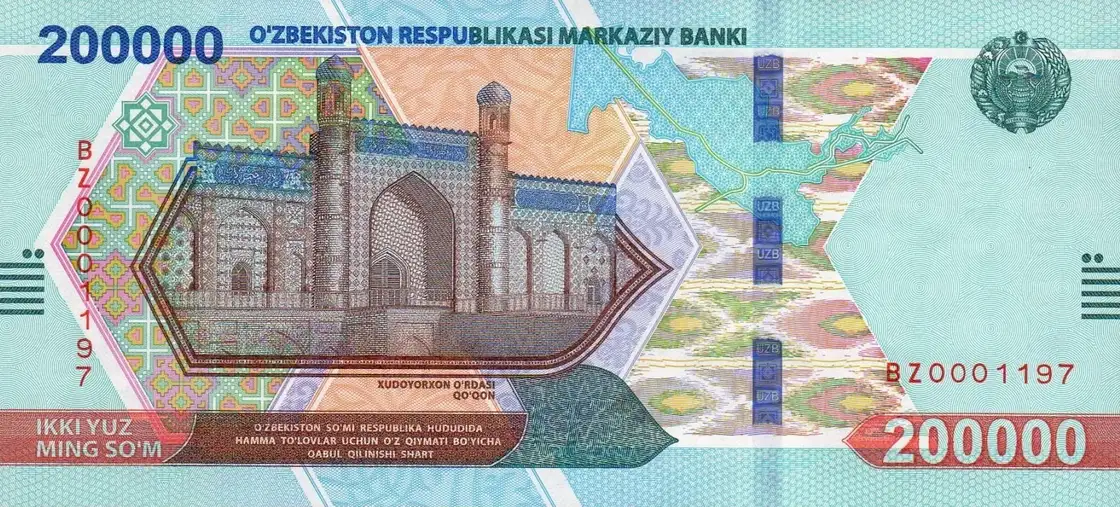
Photo: Central Bank of the Republic of Uzbekistan, Wikimedia Commons (Public domain)
Recognised your situation?
Every case has its own details. An advocate will review your documents, assess the risks and tell you what to do next.